Daily Christian Devotion

A Heart Of Gratitude Attracts God

“Sing to the Lord, for He has triumphed gloriously; the horse and his rider He has thrown into the sea.” Exodus 15:21 (ESV)

Miriam, the first prophetess mentioned in the Bible and the sister of Moses and Aaron, was born into slavery under oppression. Scholars often call her a visionary. She played a significant role in saving her baby brother Moses—watching over the basket floating along the Nile until he was found by Pharaoh’s daughter. With wisdom and courage, she ensured that their mother became Moses’ nurse in the palace. Miriam is remembered for her faith, resilience, boldness, and leadership.

During the time of Exodus, the Israelites lived under harsh bondage. They were burdened by relentless labor, crushed by taskmasters, and surrounded by an oppressive atmosphere for many generations. But after God performed miraculous signs and wonders—and after the Red Sea parted and closed behind them—freedom finally came.

Right after Israel crossed the sea and witnessed the greatest deliverance of their lives, Miriam—the prophetess—led the women with singing, dancing, tambourines, and worship.

The beautiful irony is this: even in the years of bondage, she kept a tambourine ready and a song in her heart.

No oppression, burden, or responsibility silenced her praise.

While others packed silver and gold, Miriam packed joy. She carried an instrument of worship because she expected God to move.

She became the first recorded worship leader in Scripture—ushering in praise after the long-awaited freedom from slavery.

The Bible never records Miriam complaining during captivity. Instead, she is remembered as joyful and confident in the Lord. Her immediate response to victory reveals a lifestyle of praise—not something spontaneous, but something practiced.

Miriam was content in every season because she carried worship on her lips and gratitude in her heart.

Today, the Word of God reminds us to do the same:

“Be thankful in all circumstances, for this is God’s will for you who belong to Christ Jesus.”

1 Thessalonians 5:18

When Jesus healed ten lepers, only one returned to thank Him. Jesus noticed—and He asked, “Where are the other nine?” Gratitude matters to God.

Thanking God for what He has done is gratitude.

Thanking Him for what He will do is faith.

A grateful heart attracts the presence of God. As long as breath fills your lungs, choose to thank Him.

Gratitude changes posture, perspective, and destiny. When we cultivate gratitude toward God, we also learn to appreciate people He sent to help us on the journey.

Gratitude will take you places.

Thankfulness will open doors.

Praise will bring down walls.

Prayer:

Lord, give me a heart like Miriam—full of praise, gratitude, and faith. Help me worship through every season and trust You before I see the breakthrough. Let thankfulness always flow from my heart and lips. In Jesus’ name, Amen.

Standard
Daily Christian Devotion

Be expectant—your help is on the way from The Ebenezer

“Then Samuel took a stone and set it up between Mizpah and Shen and called its name Ebenezer; for he said, ‘Till now the Lord has helped us.’

1 Samuel 7:12 (ESV)

Being helped by someone is a great privilege. Not everyone comes forward to help, and not everyone receives help at the right moment. But God never ceases to help—He shows up at the right time and in the right place. Sometimes, when we are surrounded by blessings and favor, we begin to take His help for granted. Our minds may even start to believe that God is obligated to help us, instead of responding with gratitude and reverence.

God helps us when our ways please Him and when we walk in obedience to His commandments.

1 Samuel chapters 4–7 describe a battle between the Israelites and the Philistines. Israel was known as a mighty army—not because the people were skilled, but because their God was powerful, faithful, and undefeated.

Yet Israel turned away from God. They lived in sin and began worshiping other gods. So, when the battle came, despite having a strong army, the Israelites were defeated, and 4,000 soldiers died—serving as a wake-up call.

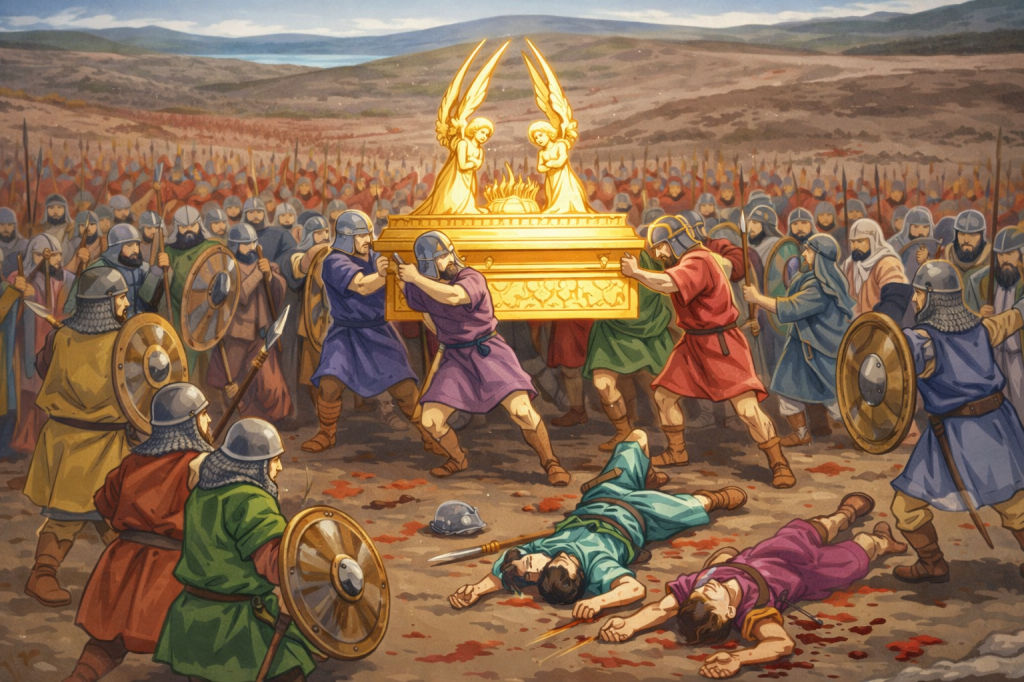
Instead of repenting, the Israelites looked for a shortcut. They brought the Ark of the Covenant into battle, thinking it would guarantee victory—treating it like a charm instead of approaching it with reverence and holiness. But once again, they were defeated—this time losing 30,000 men, and the Ark of the Covenant itself was captured.

The Philistines took the Ark, but the presence of God brought plagues and terror upon their land. In fear and trembling, they returned the Ark with a guilt offering.

At that point, Samuel the prophet called the people to repentance. He urged them to turn from idols, obey God’s commandments, and return to Him with sincere hearts.

So, all of Israel gathered at Mizpah. They fasted, worshiped, and repented. They laid aside their idols and surrendered themselves fully to the Lord.

When the Philistines heard about the gathering, they came to attack. Fear filled the people of Israel, but Samuel offered a lamb as a sacrifice and cried out to God—and God answered.

As Samuel presented the offering, the Philistines advanced—yet the Lord thundered with a mighty sound, throwing them into confusion, and they were defeated before Israel. The Israelites pursued them and drove them out.

Then Samuel set up a stone and called it Ebenezer, meaning:

“Thus far the Lord has helped us.”

This word of encouragement is for those waiting on God to intervene:

The Lord will help you—even in battle-like situations.

But do not treat God as one of many helpers—place your hope in Him as ‘The Help’.

Before I accepted Jesus as my Savior, when I felt afraid, I would place a physical Bible under my pillow or carry it with me. But I only began to experience the power of God’s Word when I surrendered my life and aligned my ways with Him. A physical Bible cannot help us—but the Spirit of God who breathed those words into existence can.

God will not move on our behalf while we hold onto idolatry—whether it shows up as pride, jealousy, fear, or unholy living.

It is not too late to repent, return to the Lord, and walk in obedience. We no longer need a lamb like Samuel offered—because we already have the Lamb of God, Jesus Christ. Through His sacrifice, His blood, and His grace, we are forgiven, restored, and positioned to receive His help and favor again.

This Ebenezer God will not let your foot slip.

He will not hand your life over to the enemy.

He will not leave you abandoned or defeated.

Be expectant—your help is on the way.

Prayer

Lord, search my heart and reveal anything that does not please You. I repent of every sin, every idol, and every attitude that has taken Your place. Help me, Lord, for You alone are my refuge, my strength, and my deliverer. Thank You that You are my Ebenezer—my ever-present help. In Jesus’ name, Amen.

Standard
Daily Christian Devotion

Remove That Veil To Reveal Your Identity

“And because you are sons, God has sent the Spirit of his Son into our hearts, crying, ‘Abba! Father!’ So you are no longer a slave, but a son, and if a son, then an heir through God.”

Galatians 4:6-7 (ESV)

There was once a very famous American pop singer who had a habit of covering his children’s faces with veils whenever they were taken out in public. No one knew what his children looked like. They could walk without attention because their identity was hidden. But if the world had known who their father was, those children would have been treated differently—honored, noticed, and given special privileges simply because of who they belonged to.

When their father passed away suddenly, everything changed. The veil was removed, and the whole world finally saw who they were. Cameras, lights, and media attention surrounded them—not because of anything they achieved, but because of the identity tied to their father.

Not every death brings privilege—but one death did.

The death of Jesus Christ opened a door the world could never shut. Sin once separated us from the Father. Shame, guilt, bondage, and darkness acted like a veil—hiding our true identity. But when Jesus died, Scripture says the veil in the temple—the one separating the Holy of Holies where God’s presence dwells—was torn from top to bottom. God removed the barrier. Jesus became the Mediator, destroying every man-made protocol to reach the Father.

Through His blood, our true identity is revealed:

We are children of the Most High.

We have access to the throne room.

We have the privilege to call Him Abba—Father.

ABBA is more than a word; it is intimacy. A child deeply loved does not call their father “parental figure”—they say: Daddy… Papa… Appa.

ABBA carries emotion, relationship, belonging.

Yet sadly, tradition, legalism, false teaching, and ignorance still veil many believers. That veil is useless—it does not protect you. It only prevents you from enjoying what is already yours in Christ.

You are chosen—not because of who you are—but because of who He is.

You were loved first.

You were known first.

You were adopted into His family through grace.

The inheritance God promised Abraham also belongs to you because you are part of His lineage—His covenant—His household.

God never hesitates when He calls you His son or daughter—it is often we who hesitate to believe it.

Jesus died to reveal your identity as Heaven sees it.

The world may label you, judge you, or define you—but those labels will never replace the truth:

You are a child of God.

And when you accept the Father’s invitation of adoption, all of Heaven turns its attention toward you and rejoices.

So remove the veil.

Walk in the identity Christ gave you.

Let the world see who your Father is…

and where you truly belong.

Prayer

Abba Father, help me to fully walk in the identity You have given me. Remove every veil of fear, shame, or limitation that keeps me from knowing You deeply. Teach me to live as Your child—with confidence, intimacy, and joy. Thank You for adopting me, redeeming me, and calling me Yours. In Jesus’ name, Amen.

Standard
Daily Christian Devotion

Peace to be with you

“As they were talking about these things, Jesus himself stood among them and said to them, ‘Peace to you!’”

Luke 24:36 (ESV)

What is wrong with these people? Why do they speak about their God all the time? Why can’t they stop preaching the gospel even when they know they are marked, hunted, killed, and beheaded for it?

If they remained silent, perhaps they could have saved their lives.

These are the thoughts that run through many minds. Yet once a person encounters Jesus, those same questions disappear. Instead, they find themselves thankful someone told them about Him—because the peace He gives is beyond what the human mind can understand.

The peace of God is the greatest gift He can pour into a soul. The first message Jesus spoke after His resurrection was, “Peace be with you.” This reveals the heart of God—that through His death and resurrection, Jesus came to give us everlasting peace.

Jesus called His disciples while they were minding their own business. They responded, left everything behind, and followed Him. They walked with Him, ate with Him, and learned from Him. Men with no earthly education came to know heavenly mysteries. They witnessed miracles with their own eyes—sins forgiven, demons fleeing, storms obeying, the blind seeing, the deaf hearing, the lame walking, and the dead rising. Multitudes were fed, the hopeless restored, and faith strengthened day by day.

Yet when Jesus spoke of His suffering and death, and when it finally happened, their hearts broke. Their hope felt shattered. The One who gathered them vanished from their sight. Grief, confusion, and fear overwhelmed them. Losing someone and trying to live with only memories takes the grace of God.

Then—right in the middle of their fear, sorrow, and uncertainty—Jesus appeared among them and spoke one simple but powerful promise:

“Peace to you.”

His presence restored courage. His peace settled their trembling hearts. Filled with the Holy Spirit, those once fearful disciples performed even greater works. They were beaten, stripped, mocked, imprisoned, and persecuted, yet nothing stopped them. Why?

Because the peace of Christ held them steady.

This peace is not logical. It does not make sense to the natural mind. It is supernatural. It guards the heart. It sustains the soul. The same Jesus who visited His disciples stands among us today, offering peace to all who listen and believe.

Those who truly receive it cannot keep the good news to themselves. This peace walks with you through the valley of the shadow of death. It sustains you in sickness. It lifts you from grief. It brings joy in chaos and rest in the storm.

“In peace I will both lie down and sleep; for you alone, O Lord, make me dwell in safety.”

Psalm 4:8 (ESV)

David wrote this during a time of great distress, while fleeing from the rebellion of his own son Absalom. It is called a Psalm of peace—proof that even in hardship, God offers peace, rest and security.

Everyone who encounters Jesus can testify to this peace. That is why believers continue to share the good news—so others may receive this free gift.

Today, this same gentle, powerful, living Jesus is offered to you.

May the grace of God open your eyes and heart to receive His peace.

Invite Jesus Christ in, and experience a peace no one can steal from you.

Prayer:

Lord Jesus, thank You for the peace that only You can give. Silence every storm in my heart and mind. Help me surrender fully to You and rest in Your presence. Fill me with Your Spirit and let Your peace guard my thoughts, my steps, and my future. In Your holy name, Amen.

Standard
Daily Christian Devotion

The Lord Who Sees

“So she called the name of the Lord who spoke to her, ‘You are a God of seeing,’ for she said, ‘Truly here I have seen him who looks after me.’ Therefore the well was called Beer-lahai-roi; it lies between Kadesh and Bered.” Genesis 16:13–14 (ESV)

A few years ago, an actress took her own life shortly after completing a shoot. Her death shocked everyone—her family, friends, and coworkers—because she showed no visible signs of sadness or distress. She looked cheerful, confident, and put together. Many of her colleagues said they never saw the slightest hint of sorrow. But behind the smile, she carried a weight so heavy that she could no longer bear it.

Many people go through life unnoticed like this. We may be surrounded by people, yet still invisible to them. A loving mother may notice even the smallest bruise on her child, and even as we grow, she can often sense when something is wrong. Yet even a mother’s love has limits—there are pains people cannot see, and struggles we cannot communicate.

But Scripture reminds us of something powerful: even when no one else sees, God sees. When others overlook us, misunderstand us, or fail to notice our pain—God is the God who watches, understands, and responds.

The story of Hagar is a beautiful reminder of this truth. Hagar was an Egyptian servant brought into Abraham’s household—likely very young, perhaps between 15 and 20 years old. She was given to Abraham as a wife, not by choice, but by command. She had no say—her voice, desires, and dignity were overlooked. She became pregnant quickly, and when tension arose, Sarah mistreated her harshly. Eventually, Abraham allowed Sarah to deal with her as she wished. Wounded, pregnant, and rejected, Hagar fled into the wilderness.

Life can be painfully unfair. Can you imagine the emotional weight that teenage girl carried? Used, dismissed, humiliated, and abandoned—she ran into loneliness with no one to defend or comfort her.

But in the wilderness—where no one saw her—God saw her. The Angel of the Lord appeared to her, spoke hope into her distress, and gave her a promise about her son and her future. Right there, beside a lonely spring of water, the place was named Beer-lahai-roi, and Hagar declared the first recorded name given to God in Scripture:

“You are the God who sees me.”

What a powerful assurance for someone who thought she was forgotten.

This passage reminds us that God sees us in our darkness and in our distress. He sees us when betrayal wounds us and when our hearts ache with silent pain no one understands. He sees us when we walk through our own wilderness seasons—overlooked by people, yet never unseen by Him. His promises stands firm in every situation in our lives.

So rest today, not in what others notice or fail to notice, but in the confidence that you are seen, known, and deeply cared for by the God of Beer-lahai-roi.

Prayer:

Lord, thank You for being the God who sees me. Help me rest in Your presence and trust Your eyes upon my life, even when others overlook me. Ame

Standard
Daily Christian Devotion

The Lord heard

“You will silence every voice raised up to accuse you.”

Isaiah 54:17 (NLT)

As humans—we are constantly judged for anything and everything we do. People around us often feel free to comment, criticize, or condemn without truly knowing us. It may come from colleagues, friends, family, neighbors, or even people who barely know us.

In some cultures, it becomes almost normal to attack a woman’s character simply because she stands alone or without a partner. Stories are created, false witnesses are formed, and people join together to tear down someone’s reputation without truth or accountability.

Even when we try to ignore these whispers behind our backs, it still hurts deeply—especially when we discover that someone close is involved. People’s opinions can weigh heavily on us and even affect our emotional and mental well-being. It becomes impossible to chase down every lie, confront every rumor, and prove the truth at every turn. One day you are celebrated, and the next day you are discarded. Too often, perception becomes louder than truth.

But when you stand in pain, feeling helpless and wounded by the words spoken against you, there is One whose shoulders you can lean on—Jesus Christ.

God cares about your name, reputation, and identity. He hears every word spoken in secret, every careless accusation, every lie built without evidence. He sees what you haven’t seen and hears what never reached your ears. Nothing escapes His notice—not even a whisper.

In Numbers 12, Miriam and Aaron—Moses’ own siblings—spoke against him. They questioned his unique relationship with God and criticized his marriage to a Cushite woman. Moses, humble and unaware of their conversation, did not defend himself. But Scripture says, “The Lord heard.”

God called all three out from their tents and confronted Miriam and Aaron. He defended Moses, confirmed his faithfulness, and declared how personally and clearly He communicated with him—mouth to mouth, not in riddles. Miriam was immediately struck with leprosy as judgment, and though Moses pleaded for her healing, she remained outside the camp seven days.

God Himself became Moses’ defender.

“Not so with my servant Moses. He is faithful in all my house. With him I speak mouth to mouth, clearly and not in riddles, and he beholds the form of the Lord. Why then were you not afraid to speak against my servant Moses?”

—Numbers 12:8 (ESV)

The Word of God reminds you today: The Lord hears every word spoken against you.

The same God who defended Moses will defend you. He is omnipresent, omniscient, and omnipotent. Not a single word raised against you goes unnoticed.

You will see the Lord’s judgment and His justice in His perfect time. Stand firm. God will silence every voice raised against you.

Prayer

Father, thank You that You are my defender and my shield. When words rise against me, help me remain still and trust. Silence every voice that speaks falsely against me and establish Your peace, justice, and honor over my life. In Jesus’ name, Amen.

Standard
Daily Christian Devotion

You will not run dry

“The jar of flour will not be used up and the jug of oil will not run dry until the day the Lord sends rain on the land.”

1 Kings 17:14

Everyone enjoys feeling seen, valued, and prioritized. When someone makes us their priority, it reassures us that we matter. In the same way, Scripture reminds us of the importance of giving God first place in our lives. In our time, relationships, resources, and decisions—when God comes first, we will never run dry.

The story of Elijah and the widow reveals this truth. Elijah approached a widow gathering sticks and asked her for bread. She replied that she had only a little flour and oil left—just enough for her and her son to eat one final meal before dying. Famine filled the land, resources were scarce, and hope was fading. Yet Elijah asked her to make his portion first and assured her of God’s promise:

In faith, the woman obeyed. With her little, she honored God first—and as promised, her oil and flour never ran out until the famine ended.

Likewise, when we give God the first in every circumstance—not only when it is easy, but in everything—we position ourselves under His provision. Making God our first priority opens the door for His kingdom to move on our behalf.

Keeping God first means seeking Him, honoring Him, trusting Him, and thanking Him for who He is. Throughout Scripture, not one person who put God first was abandoned, forgotten, or left without help.

Be faithful with what God has entrusted to you:

• Give Him the first hour of your day.

• Give Him the first tenth of your income.

• Seek Him before leaning on relationships or people.

• Acknowledge Him in every decision.

“But seek first the kingdom of God and his righteousness, and all these things will be added to you.” Matthew 6:33 (ESV)

Jesus teaches us to prioritize the kingdom first—and then everything else will align. Yet many times, we reverse the order. We seek everything else first and leave God last. We are careful not to offend people, yet easily grieve God. We strive to please others and forget to please the One who sustains us.

We cannot treat God as our last priority and expect Him to treat us as His first. The measure we give Him becomes the measure we receive.

Seeking anything without first seeking God leads to exhaustion, emptiness, and striving without fulfillment. But when God is first, everything else falls into its rightful place.

Keep God first—and watch His kingdom move on your behalf. You will not run dry.

Prayer

Father, teach me to put You first in every area of my life. Strengthen my faith like the widow, so that even in lack or uncertainty, I trust Your provision. Thank You that when You are first, lack cannot reign, fear cannot rule, and I will not run dry.

In Jesus’ name, Amen.

Standard
Daily Christian Devotion

God’s covenant still stands true

Since there was no one greater to swear by, God took an oath in his own name, saying, “Surely I will bless you and multiply you

Hebrews 6:13-14 ESV

In ancient times, covenant ceremonies were sacred and solemn. Animals were cut in half, symbolizing that whoever broke the covenant would suffer the same fate. Both parties would walk between the pieces, signifying their commitment to uphold the agreement.

When God made a covenant with Abraham in Genesis 15, He instructed him to bring a three-year-old heifer, a three-year-old female goat, a three-year-old ram, a turtledove, and a young pigeon. Abraham obeyed—he presented them to the Lord, killed them, and laid the halves side by side. As he fell into a deep sleep, the Bible says a thick and dreadful darkness came over him, and God Himself made a covenant with Abraham, promising to bless him and his descendants forever.

“After the sun went down and darkness fell, Abram saw a smoking firepot and a flaming torch pass between the halves of the carcasses.” Genesis 15:17 (NLT)

God alone passed between the pieces—showing that the covenant’s fulfillment rested solely on His promise, not on Abraham’s ability to keep it. God knew Abraham would fail, and humanity would fail too. Therefore, God swore by Himself—because there is no one greater—ensuring His promise would stand through all generations.

This sacrificial act pointed forward to Jesus Christ, the ultimate sacrifice who renewed the covenant between God and humanity through His blood. The covenant still stands today, and the promise still remains over you and your generations.

But to walk in agreement with this everlasting covenant, you must believe in the sacrifice of Jesus Christ on the cross. God does not look at your good deeds, charity, or the kindness of your heart as the entry point into this covenant. These are beautiful reflections of Christ’s love, but they cannot replace faith in His finished work. Only by believing in the blood of Jesus—the sacrificial Lamb—can you step into the Abrahamic covenant and its blessings for you and your descendants.

When God swore by Himself, He declared that there is no one greater. He has no equal. He is the Great I Am. He is not a man that He should lie, nor unfaithful like us. What He has spoken will be fulfilled.

If you feel distant from God today, know that His covenant still stands. Come back into the everlasting covenant He established through Jesus Christ. Believe in His sacrifice, and you will experience the promises of Abraham upon your life.

Your perfection cannot bring you into this covenant—but the blood of Jesus Christ can.

Prayer:

Heavenly Father, thank You for the everlasting covenant You established through Your Son, Jesus Christ. Help me to believe fully in His sacrifice and walk in the blessings of the Abrahamic promise. Renew my heart and draw me closer to You. In Jesus’ name, Amen.

Standard
Daily Christian Devotion

The storm will not destroy you

“Yet now I urge you to take heart, for there will be no loss of life among you, but only of the ship.”

Acts 27:22 ESV

Paul was falsely accused by the Jews of causing trouble, though the Roman courts found no fault in him. As a Roman citizen, he appealed to stand trial before Emperor Caesar and was sent to Rome by ship with other prisoners and guards.

Soon after setting sail, a violent Northeaster storm struck, tossing the ship helplessly across the Mediterranean. In the midst of the chaos, God sent an angel to Paul, assuring him that though the ship would be destroyed, every one of the 276 people on board would survive. Strengthened by this promise, Paul encouraged everyone to eat and take heart after fourteen days without food.

As the storm raged on, the sailors sensed land and dropped anchors. At dawn, they tried to steer toward the shore, but the ship hit a sandbar and began to break apart. Yet, just as God had said, not one life was lost—some swam, others clung to planks, and all reached the shore safely.

This story reminds us that even in life’s fiercest storms, God’s word stands firm. Paul began that journey accused, rejected, and bound as a prisoner—but in the midst of destruction, he became a voice of faith and strength. What looked like a shipwreck turned into a testimony of divine preservation. The storm may have damaged the vessel, but it could not touch the lives God had marked for purpose.

So, do not be afraid of the storms that rise against you. Even when accusations, trials, or lies surround you, remember that God’s promises are stronger than the waves. The storm may shake you, but it will not destroy you. You will reach the other side safely. God will carry you through every breaking moment and bring you to the place He has destined for you.

Prayer:

Heavenly Father, thank You for being my anchor in every storm. When life feels out of control, remind me that Your promises still stand.Help me trust that even through the wreckage, You are guiding me safely to shore. In Jesus’ name, Amen.

Standard
Daily Christian Devotion

Claim your mountain

“And Moses swore on that day, saying, ‘Surely the land on which your foot has trodden shall be an inheritance for you and your children forever, because you have wholly followed the Lord my God.’”

Joshua 14:9 (ESV)

Moses swore to Caleb, saying, “The land on which your foot has walked shall be your inheritance, and for your descendants after you.” Many years later, Caleb reminded Joshua of this promise—almost like writing a heartfelt letter to reclaim what was rightfully his through God’s word.

Caleb was one of the spies who saw both the giants and the promise of God. Yet, instead of being intimidated by the size of his enemies, he held on to faith and fought courageously. He wholly followed the Lord, obeyed His every instruction, and loved Him with all his heart. Because of this, he was qualified to receive his inheritance.

Caleb requested Hebron—a mountainous region rich in history. It was the same place where Abraham had once settled, built an altar, and where God reaffirmed His covenant with him. Later, after Saul’s death, David was anointed king in Hebron and reigned there for seven and a half years before moving his capital to Jerusalem.

This passage is a great encouragement for those who have been faithfully walking with the Lord. Every place where your foot treads, the Lord promises to give you as an inheritance. Your faithfulness, tears, and endurance for God’s sake will not be in vain. The battles you face will not only end in victory but will stand as milestones in your spiritual journey.

Keep pressing on—your Hebron is waiting. Though the promise may seem delayed, what God has spoken over your life will surely come to pass. For your faithfulness’ sake, your children and their children will be blessed. Your walk with God will become a turning point for generations to come. You will no longer be a wanderer or walk in uncertainty, for those who love the Lord wholeheartedly will inherit His promises forever.

Prayer:

Heavenly Father, thank You for Your unfailing promises. Teach me to walk faithfully as Caleb did, with courage and wholehearted devotion. May Your promises be fulfilled in my life and in the generations that follow me. In Jesus’ name, Amen.

Standard