“We destroy arguments and every lofty opinion raised against the knowledge of God, and take every thought captive to obey Christ.”
2 Corinthians 10:5 ESV
There was once a young man in a village who was constantly troubled by fear, which stole his peace. The villagers advised him to visit a wise old man who lived far away, believing he could help him overcome his fears. Encouraged, the young man traveled to the distant village.
The old man handed him a glass filled to the brim with water and said, “Take this glass to the edge of the valley and return without spilling a single drop.” Determined, the young man fixed his eyes on the glass. Along the way, he ignored every distraction—the busy villagers, barking dogs, playful children, and the noise around him. At last, he returned without spilling a drop.
The old man then revealed the lesson: “You succeeded because you kept your focus on the glass of water, refusing to pay attention to the noise and distractions. In the same way, calm your mind and focus, and you will find peace.” The young man returned to his village with joy.
Likewise, Scripture tells us of a time when Jesus asked His disciples to cross to the other side of the sea after a long day. As they journeyed, a sudden storm arose, and the waves began to swamp the boat. Terrified, the disciples woke Jesus, who was asleep. He rebuked the storm, calmed the waters, and questioned their faith.
What is striking is that some of these disciples were fishermen, well acquainted with the dangers of the sea. Normally, they would have known how to handle such a storm, but fear gripped them. Instead of focusing on Jesus, they focused on the storm. These same men had walked with Jesus and seen His power, yet in that moment, fear crippled their faith.
Similarly, when God gives us a mission, the enemy often fills our minds with distracting questions like: When should I go? How will I go? Why should I go? What if something happens? Will I even go? If we let fear take control, it paralyzes us. But the Word of God calls us to trust, to step into the boat, and to fix our eyes on Jesus—the Living Water.
As we meditate on His Word and surrender our thoughts to Him, our minds are stilled and tamed. Even in the midst of storms, noise, and distractions, we can remain at peace because the Prince of Peace is with us. The question is not how strong the storm is, but whether Jesus is in your boat. If He is, you are safe.
Take every thought captive to obey Christ, and He will give you perfect peace.
Prayer:
Lord, thank You for every storm-like situation in my life. Please fill my mind with Your life-giving Word, help me to focus on You, and grant me Your peace. In Jesus’ name, Amen.
But Elisha sent a messenger out to him with this message: ‘Go and wash yourself seven times in the Jordan River. Then your skin will be restored, and you will be healed of your leprosy.’”
—2 Kings 5:10 (NLT)
Naaman, the commander of the Syrian army, had an excellent track record of victories. He was influential, blessed, and famous. Yet despite his greatness, he was afflicted with leprosy—a disease considered unclean in those days.
During one of his campaigns, Naaman’s army captured a young girl from Israel, who was then placed in service as a helper to his wife. This little girl, though a captive, cared enough to point her master toward healing. She told her mistress that Naaman could be healed if he went to the prophet in Israel.
Interestingly, the Bible does not say that Naaman was actively searching for healing. Perhaps he had grown weary of trying and had resigned himself to living with the disease. But the girl’s simple words stirred a new possibility. She believed that what others saw as a hopeless condition, God could cleanse.
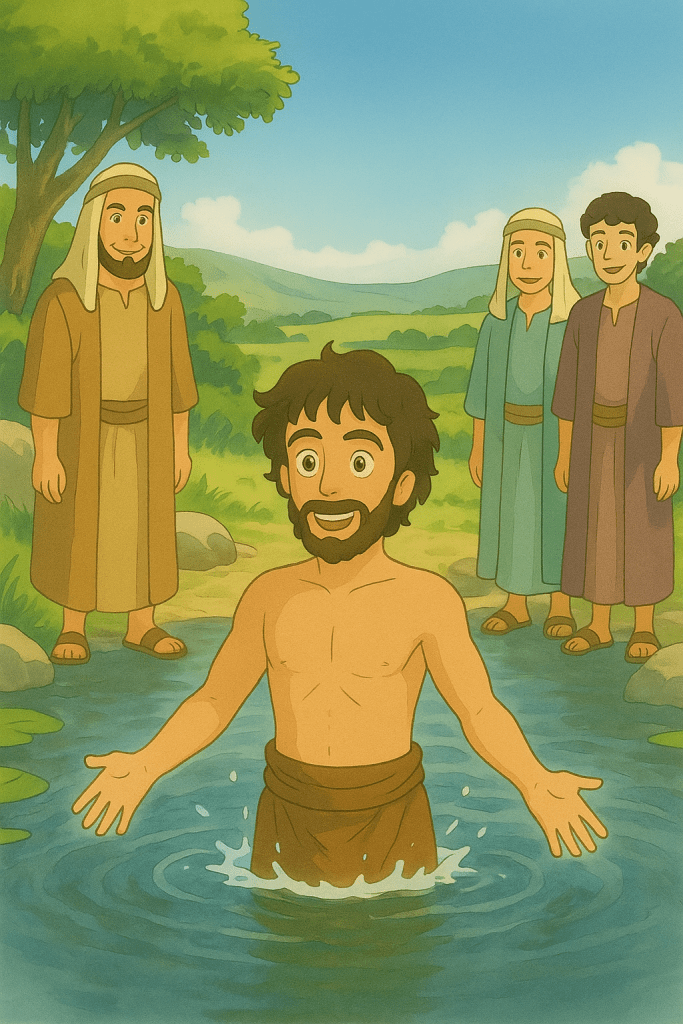
Naaman listened. He traveled to Israel, expecting a dramatic encounter with the prophet Elisha—perhaps a public display of prayer, or the prophet waving his hand over him to bring healing. Instead, Elisha did not even meet him in person. He simply sent a messenger, instructing Naaman to dip himself in the Jordan River seven times.
Naaman was offended. To him, the Jordan seemed inferior compared to the great rivers of his homeland. He was ready to walk away in anger. But his officers tried to reason with him and said, “Sir, if the prophet had told you to do something very difficult, wouldn’t you have done it? So you should certainly obey him when he says simply, ‘Go and wash and be cured!’” (2 Kings 5:13, NLT).
The real struggle for Naaman was not dipping into the water—it was accepting that such a great deliverance could come through something so simple. Yet when he humbled himself and obeyed, he dipped, he washed, and he came out with skin like that of a child. He was made clean. Naaman praised the God of Israel and chose to live a godly life thereafter.
Even today, many people around the world long for healing, deliverance, or breakthrough. Some are misled into believing they must endure complex, exhausting, or painful processes to receive it. But the Word of God reminds us that the greatest work has already been accomplished on the cross.
Salvation, healing, and a brand-new start are not earned by difficult rituals—they are received through a simple act of faith. All you need to do is surrender your heart to Jesus, believe that His blood can wash you clean, and accept His forgiveness.
You may wonder, “Can something this great really come from something so simple?” Yes—it can. Just as Naaman discovered, God’s power is revealed through humble obedience and simple faith.
Today, I encourage you: Believe in Jesus. Trust His Word. And you will see your life restored—filled with peace, purpose, and the joy of a new beginning.
Prayer:
Lord, thank You for Jesus Christ, who took our burdens upon the cross and cleansed our sins by His blood. Today, I accept the forgiveness He offers and the brand-new start You have given me. In Jesus’ name, Amen.
“Go; let it be done for you as you have believed.” – Matthew 8:13
In today’s passage, we meet a Roman centurion—a man of power, prestige, and influence who commanded many soldiers. At this time, Rome ruled Judea with great authority, and Roman soldiers were often viewed as oppressors. Yet something about Jesus captured the centurion’s attention and began to soften his heart.
He observed Jesus closely. He saw compassion in His teaching, authority in His miracles, and a power that was not of this world. What others overlooked, the centurion believed.
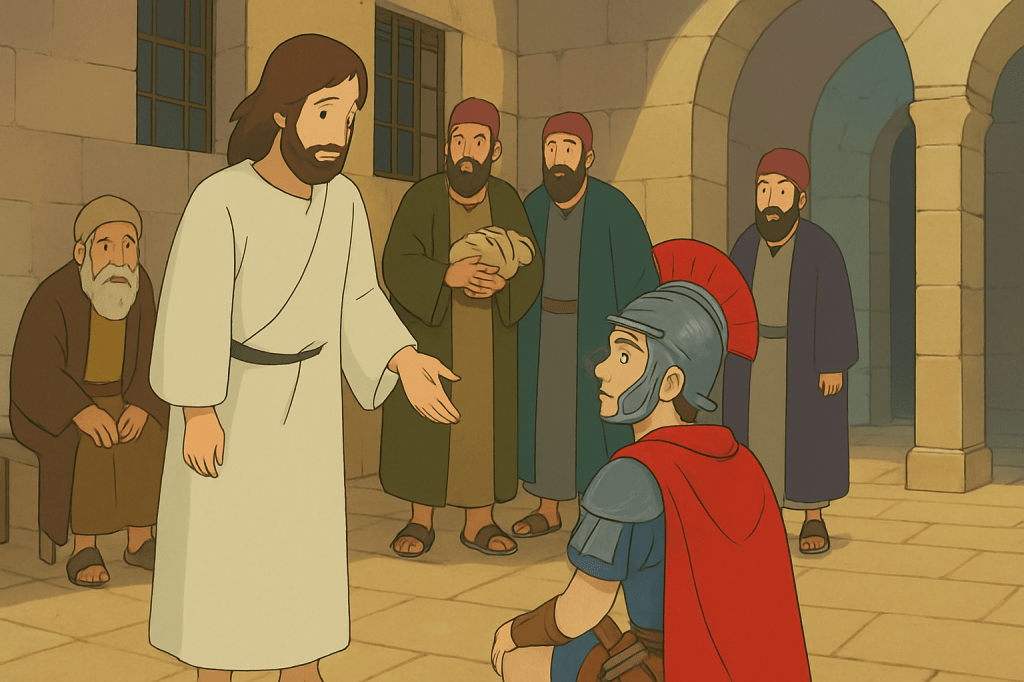
When his servant lay paralyzed and suffering, the centurion came forward in faith and appealed to Jesus for healing. Jesus immediately responded, “I will come and heal him.” But the centurion replied, “Lord, I am not worthy to have you come under my roof, but only say the word, and my servant will be healed.” Though he was a man of authority, he recognized that Jesus’ authority was far greater—authority over sickness, over suffering, and over all creation.
With only a few brief encounters, he grasped a truth that even many of Jesus’ own people missed. Jesus marveled at his faith and declared: “Go; let it be done for you as you have believed.” At that very moment, the servant was healed.
• The centurion believed Jesus has authority over sickness.
• The centurion believed Jesus is full of compassion.
• The centurion believed that when you ask, you will receive.
So, where is your belief today? Is it in your position, your family, your resources, or your own strength? Or is it anchored in Jesus—the One who holds true authority and compassion?
Today’s word invites us to come forward like the centurion. Lay aside who you are, and remember who Jesus is. If you place your belief in your own wisdom and power, you will remain lying in suffering. But when you place your belief in Jesus, His Word brings breakthrough, healing, and hope.
As you believe, so shall it be done for you.
Prayer:
Lord, thank You for Your compassion toward us. Please give us faith that brings breakthrough in our lives. In Jesus’ name, we ask. Amen.
It was the Sabbath—a day when the Jewish people were commanded to refrain from various form of works and to rest and worship. As Jesus was teaching in the synagogue, a man entered with a withered hand.
Medically, a withered hand is a condition where knots form in the tissue under the palm, eventually hardening the muscle and pulling the fingers inward. There is no permanent cure. Spiritually, it represents an inability or restricted to do good works.
The irony is that Jesus chose to heal this man on the Sabbath. It seems the man was brought in intentionally so the leaders could accuse Jesus of breaking the law. But Jesus, knowing their intentions, wasted no time. He called the man to stand before everyone and then commanded, “Stretch out your hand.” Immediately, the curled-up hand opened—fully restored for use.
The leaders watched the healing and became furious, plotting against Jesus—not for doing wrong, but for doing good. This reminds us that some people will accuse or oppose you even when you do the right thing. In our world, few seek approval to help, while many are selective about who receives the honor, even placing human-made laws and restrictions on when, where, and to whom good should be done.
This is the spiritual “withered hand” disease—shrinking our ability and willingness to help. But Jesus demonstrates that compassion has no restrictions. There is no set place, time, or person required to do good—just do good.
Bible also teaches, “So then, as we have opportunity, let us do good to everyone.” – Galatians 6:10
To all who feel their “hand” has withered—whether through fear, criticism, or discouragement—Jesus commands you today: Stretch out your hand. Stretch your horizon. Stretch your ability to do good any time, any where and to anyone.
Prayer:
Dear Father, thank You for the help we have received in every circumstance. Help us, guide us, and lead us to do good to others in all situations. Amen.
“For whoever drinks of the water that I will give him will never be thirsty again.” – John 4:14
Jesus and His disciples take a diversion into the least favorite place for the Jews—named Samaria.
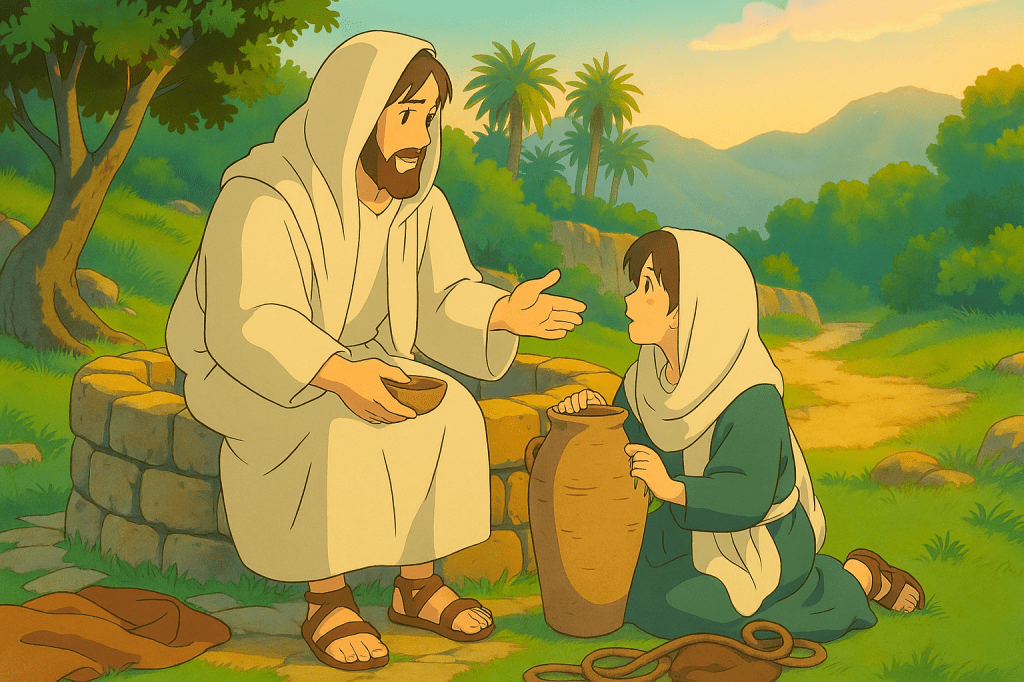
One woman from a socially outcast community comes to draw water around noon. This was a very odd time for women in those days to draw water. The act of drawing water was also a social gathering to meet and greet other women, which usually happened either early in the morning or late in the evening. It seems that this woman had chosen a time when no one else would be around the well.
The Bible says that this woman had been rejected by five of her husbands, which might also be a reason why the other women in the society did not accept her. She seemed to be a complete package of rejection, pain, and isolation.
In a surprising moment, Jesus engages in conversation with this woman—someone who isolated herself because of who she was. In her loneliness, she meets someone great in that lonely place, alone.
Jesus speaks her love language, using the metaphor of water. He reveals that He is the Living Water, representing spiritual nourishment, and also declares the greatest message of all time—that He is the prophesied Messiah, the Savior of the world. The woman’s reception of this truth is like an encounter with a well of love.
The love of Jesus Christ satisfies her thirst and longing for genuine love, which had been denied to her. The revelation of who Jesus Christ is transforms her from brokenness to boldness. She runs into the town of Samaria, carrying the message of love and the Source of love—Jesus Christ.
The joy was overflowing; she couldn’t contain it. The same lonely feet that once dragged in despair now ran with joy to share the truth.
Rejection is so real, even in this modern world. Rejection is one of the main causes of depression. We can experience loneliness and isolation, even when surrounded by many—it’s a slow poison that drains our body, mind, and soul.
To all the outcast reading this—the word of encouragement comes to you: Drink from the well of Living Water, Jesus Christ. He never runs dry. As you dig deeper for truth, the Living Water will overflow with love that will stop your thirst for human love.
God’s kingdom has a greater inclusion policy—you are part of a divine plan. His plan includes you, and as it fills your heart, your feet will automatically run to share the great news: the love of Jesus Christ.
Get ready. Dig deep. Drink in abundance—and never thirst again.
Prayer:
Thank You, Father, for Jesus Christ. Thank You for the privilege of being included in Your kingdom. Fill me with Your Living Water. Amen.
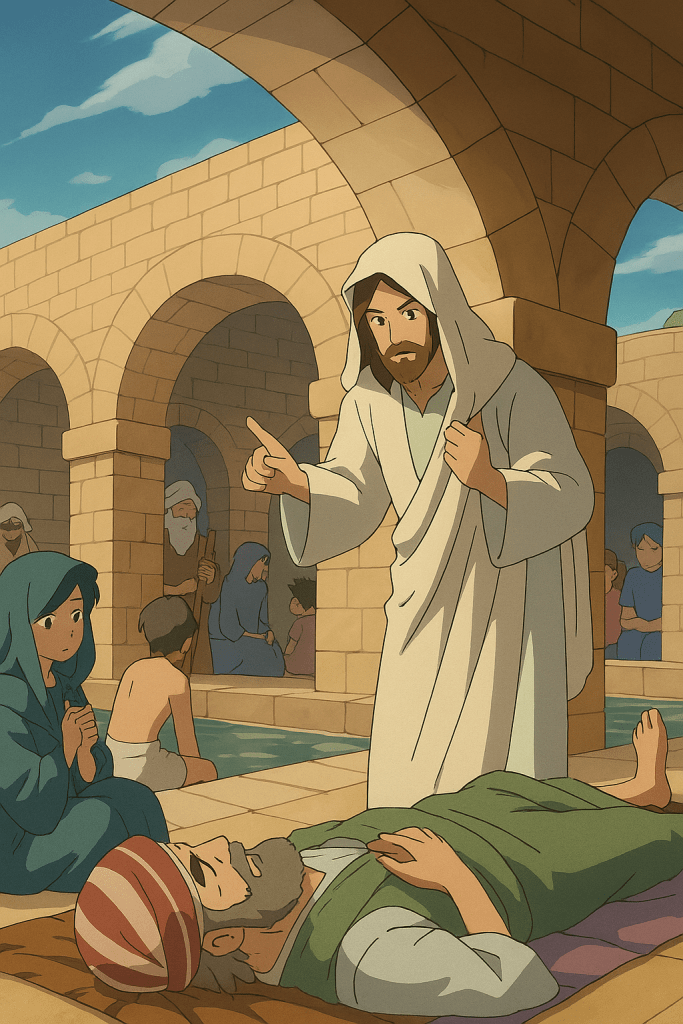
In today’s passage, we see that some are celebrating while others are walking through seasons of suffering and darkness. At Bethesda, these two realities existed side by side. It was a place where the invalid, blind, lame, and paralyzed gathered—people longing for attention and help, waiting for someone to carry them into the pool where they believed healing and deliverance could be found.
Here, the paralytic man’s perspective was shaped by the people around him. The place had become an attraction for hopelessness. This man may have been forced to stay away from celebrations due to social stigma or abandoned because of financial hardship. His world had taught him to look to man for help, and he had grown comfortable lying in the same place, with the same people, hearing the same stories, and expecting the same help.
I’m sure news of celebration and of Jesus’ presence had reached that place, but perhaps the paralytic man was too occupied with hearing bad news. And thirty-eight years is a long time to go without hearing the good news.
While the paralytic man was searching for a man, the eyes of Jesus fell on him. The Bible says Jesus knew he had been there a long time. Even when Jesus asked if he wanted to be healed, the man’s response focused on his lack of human help.
But Jesus stepped into the situation so the paralytic man could step out—out of the dark world he had been bound in for far too long.
“Get up, take up your bed, and walk.” – John 5:8
Today’s word comes as encouragement: Jesus sees us in our seasons of discouragement and repeated disappointments. When the Savior’s eyes fall on us, the bondage that has held us for too long will be broken. We can no longer remain in the comfort zone; we must be ready to step out into His glorious light.
Even today, Jesus sees you. Seek His face through prayer and worship, believing for a great move of God in your life.
You heard that right—get up and move. Your time has come, and your Savior is here.
Prayer:
Dear Heavenly Father help me to get up from my comfort zone and experience a mighty deliverance. Amen
It was the last time my husband was conscious enough to recognize me.
In the blink of a second, everything changed. The doctors in the room were having serious discussions. I wasn’t allowed in. My heart raced as I stood outside, helpless, trying to make sense of the chaos. Then, they moved him to another branch of the hospital.
The diagnosis was devastating—a massive stroke in the brain stem. The doctors were shocked. He was just 34 years old—no smoking, no drinking, a regular at the gym, a healthy adult by every standard. They were furious and confused. I had never once seen him sick. He had never complained of any illness.
To me, everything went blank.
That night, I sat alone in the hospital lobby, numb and disoriented.
The next day, my mom arrived. She had left my three-year-old daughter in someone else’s care to be with me. The moment I saw her, I broke down. I sobbed uncontrollably in her arms. She looked shattered too—seeing the youngest of her five children, the baby of our family, facing such a situation.
She did her best to comfort me, though I knew she was breaking inside.
Still, I was forced to gather myself. I had to be strong enough to take him for ultrasounds and other tests. His eyes never opened. Not once.
Yet again, I had to travel alone with him in an alarming ambulance to another hospital branch. There, the doctors prepared for emergency brain surgery. The clot was putting dangerous pressure on the skull. They had to open it to relieve it. Prayers poured in like clouds from all corners. I held onto hope—any sliver of it—for a miracle after surgery.
But what followed broke me even further.
The doctors wouldn’t give me proper updates. One of them coldly said, “Are you expecting me to say your husband is alright?”
That single sentence crushed my heart. I realized something deeply painful:
My pain was mine alone.
To that doctor, my husband was just another patient.
To me, he was my whole world.
My in-laws and sister-in-law, along with my siblings, flew in from around the world to be with me. Their presence meant the world.
Still, I struggled to face my in-laws. They are some of the kindest souls I have ever met, and this—this was their only son. I could see the sorrow etched into their faces. Yet, with unimaginable grace, they kept their pain aside to give me hope.
They came straight from the airport to the hospital. Being medical professionals themselves, the doctors spoke more openly with them than with emotionally overwhelmed me. But even then, there was no real improvement. Just observation. More waiting. More despair.
I sent everyone back home and chose to stay another night in the hospital—alone.
This time, I wasn’t allowed near the critical care unit. I had to stay in a separate building. I walked through dark hospital pathways, full of fear and uncertainty.
The infrastructure didn’t scare me—the pain did.
Family members clung to each other, crying, praying, whispering desperate hopes for their loved ones. The air itself was heavy with grief.
I don’t remember eating. I barely slept.
And watching others suffer only deepened my ache.
I wished I had a healing wand to make everything better—for them and for myself.
I spent the whole night walking between the hospital and lodging building.
At one point, someone asked me if I had admitted an elderly person.
I couldn’t even form the words to explain what had happened.
Soon, my family arrived again the next morning. My eyes were swollen from days of tears. I waited anxiously for the doctors’ morning rounds. I hoped—pleaded in silence—for good news.
Instead, I was told the other side of his brain had started bleeding.
My hope began to crumble.
Fear.
Anxiety.
They gripped my soul like never before.
My siblings softened their words, trying to cushion the blow. But I understood.
Others in the hospital lodge began asking, “Why are you here alone? What’s going on?”
Slowly, I started to open up. They began to share their pain too. We cried together.
We held on to each other.
We whispered encouragement.
We begged heaven for mercy.
I saw some patients move to normal wards.
Some were discharged.
Something good was happening around me—but not to me.
Not yet.
It became a ritual—I stood before the doctors during every round.
They gave me bad news after bad news.
And afterward, I would sit alone in the lobby, watching everyone walk in.
Everyone who entered that building had a story.
One day, I saw a young woman rush in, crying. Her husband had a brain injury from an accident. She was frantic. Something stirred in me.
I walked over. I listened. I comforted her.
“I believe your husband will be okay,” I told her gently.
She hugged me with tear-filled eyes.
In that moment, I felt something good—for the first time in days.
Even though I knew the doctor would soon come to give me another terrifying update.
In that hospital I saw babies treated for brain cancer.
Young children.
Elderly people.
Some went home.
Some didn’t and was declared dead.
The hospital was a sea of emotions.
I started to sit quietly and listen to my soul.
Why am I going through this?
What is the purpose of this pain?
I had chosen a simple life.
Yet, What lesson was hidden here?
In that silence, something began to speak to me.
A glimpse of my future—who would help me, what I would walk through.
It came like a movie in my mind.
I kept it to myself.
I wasn’t sure if it was divine or just my imagination.
After several days, my family insisted I go home.
My daughter had started to ask for me.
It had been few days—and I hadn’t even thought about her.
When I walked through the door, she ran into my arms.
Her tiny hands wrapped tightly around my neck.
She kissed me endlessly.
Her puzzled face said everything, but she didn’t ask about her daddy.




 4mthesoul