“The Lord does not look at the things people look at. People look at the outward appearance, but the Lord looks at the heart.”
A man named Jesse lived in Bethlehem with his eight sons. Jesse was a farmer and a sheep breeder. His older sons served as soldiers in Israel’s army, alongside the king. But the youngest, David, was only a shepherd and a skilled musician.
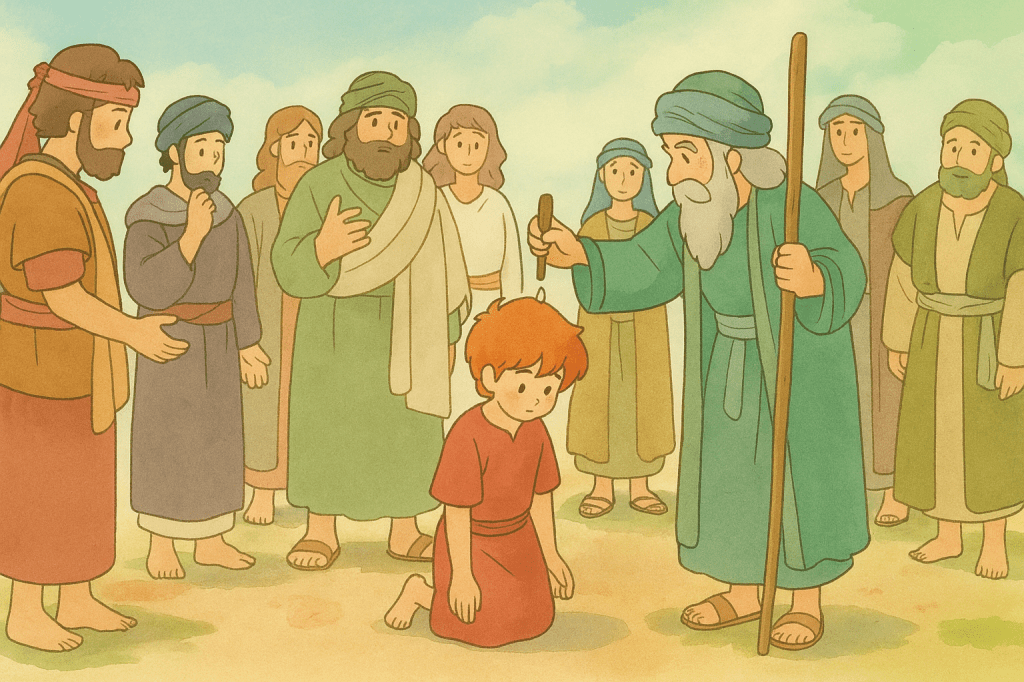
God instructed the prophet Samuel to anoint one of Jesse’s sons as the future king of Israel. After the ceremonial cleansing and sacrifice with Jesse’s family, Samuel began to search for God’s chosen one. His eyes were immediately drawn to Jesse’s oldest son. Tall, strong, and already a leader in the army, the prophet assumed he must be the one. But the Lord quickly corrected him, saying, “Do not look at his appearance or his height, for I look at the heart.”
Jesse, too, likely felt disappointed. In those times, the eldest son usually carried the family’s honor, responsibility, and leadership. His eldest seemed perfectly fit to be king—with strength, skills, and military experience. Yet Samuel rejected him. One by one, Jesse presented his sons, but each time the prophet said no.
After showing all seven of his sons, each with an impressive profile, Jesse finally said to the prophet that he had no more who were qualified to be king. But Samuel was not convinced, because he knew for certain that God had sent him on this mission. He asked Jesse, “Are these all the sons you have?”
Reluctantly, Jesse replied, almost as an excuse: “Yes, but he is out in the field taking care of the sheep.” The father who eagerly presented his older sons showed no enthusiasm to present David. In Jesse’s eyes, David was fit only to tend sheep and play music when needed. David did not even cross his earthly father’s mind. But God already had a rescue plan prepared, choosing the humble young shepherd boy.
While Jesse saw David as running after sheep, God was training him to fight bears and lions. While his brothers used arrows and swords in the army, God trained David to snatch lambs from the mouth of wild beasts. These were practical lessons in how to love, care for, and rescue people. His brothers were taught to dress like warriors, but David was clothed with strength from God.
The prophet was adamant to see David and even refused to eat until David was brought before him. What the earthly father failed to see, the Heavenly Father had already planned. When Samuel saw David, he anointed him, and God placed a future king on the throne.
This word encourages us today: we serve a God who sees what others fail to notice. God has a plan for you, no matter how lonely or humiliated your place may look. He is building resilience, forming strength, and preparing you in secret. Your gifts and talents may even be suppressed by your own loved ones, but God will send help—just as He sent Samuel—to reveal the identity He has marked for you.
Human effort, without a heart aligned to God’s values, will be rejected. But the Lord, honors the humble, redeems the rejected and makes the kind-hearted into a king, a leader for His glory. Just as David became king, one day you too will sit before the Lord and sing with gratitude:
“Who am I, O Sovereign Lord, and what is my family, that you have brought me this far?”
—2 Samuel 7:18 (NLT)
Prayer
Dear Heavenly Father, thank You for not seeing me the way people see me. Thank You for working in my life, even when I feel hidden or overlooked. Today I choose to trust Your plans and stand in faith, believing You are preparing me for greater things. In Jesus’ name I pray, Amen.
“You come against me with sword and spear and javelin, but I come against you in the name of the Lord Almighty, the God of the armies of Israel, whom you have defied.” 1 Samuel 17:45
David was a shepherd boy who usually brought food to his brothers in the army every day. One day, he happened to see Goliath, the giant, who came out day after day for forty days, exposing the inability of the Israelite army to defeat him. All the soldiers were humiliated by the giant, but David volunteered to fight him.
He expressed his willingness to face Goliath. King Saul tried to convince him that the giant had been a warrior since his youth. But David did not accept Saul’s words. Instead, he laid down his “CV,” explaining how he struck down lions and bears and rescued sheep from their mouths. He went on to describe his skills and how he defended himself when the beasts turned against him.
For David, fighting Goliath was just another act of courage, like when he was shepherding. He believed that the same God who gave him victory in rescuing and defending his flock would also be with him as he faced this giant. David was not intimidated—whether by a terrifying animal or a mighty warrior. He knew the weapons he had were powerful enough, with God’s help, to bring down Goliath.
Somehow, David convinced King Saul. Saul gave him his tunic, his coat of armor, and a bronze helmet. David tried them on, but he could not walk properly with the sword and armor. He declined Saul’s defense mechanisms and instead took his staff, five small stones, his shepherd’s bag, and a sling in his hand.
David prepared himself for battle and was content with what he had because his trust was in Almighty God.
Then, the tall, fully armored giant stepped forward with his shield to defend himself against the unarmed shepherd boy. Goliath saw David as a healthy, handsome young man but mocked him, saying he would soon become food for the birds. But while Goliath saw a boy, God saw a warrior and the future king of Israel.
The first thing Goliath noticed was David’s simple weapon, his staff, and he threatened him. But David responded that while Goliath came against him with sword, spear, and javelin, he came against Goliath in the name of the Lord Almighty, the God of the armies of Israel.
Long story short, David marched forward with boldness. He placed a stone in his sling, released it, and struck Goliath on the forehead. The giant fell face down, and David cut off his head with Goliath’s own sword.
David won the battle with his own identity—his shepherd’s dress and shepherd’s tools. He was uncomfortable carrying Saul’s identity as a warrior.
Today, the Word encourages us that God has been preparing, molding, and equipping you for your battles. We carry an identity in the Kingdom of God. Instead of trying to wear someone else’s identity or handle situations the way others do, embrace who you are, the gifts you have, and where God has placed you. Trust Him, for He is the greatest weapon. Take courage with what you are equipped with—the battle is not yours but the Lord’s.
The same God who has rescued, protected, and guarded you in the past is still faithful and powerful to give you victory in every giant-like situation.
Prayer
Lord, thank You for all that You have been building in me. Give me the courage to face the battles ahead of me. In Jesus’ name I pray, Amen.
It was the Sabbath—a day when the Jewish people were commanded to refrain from various form of works and to rest and worship. As Jesus was teaching in the synagogue, a man entered with a withered hand.
Medically, a withered hand is a condition where knots form in the tissue under the palm, eventually hardening the muscle and pulling the fingers inward. There is no permanent cure. Spiritually, it represents an inability or restricted to do good works.
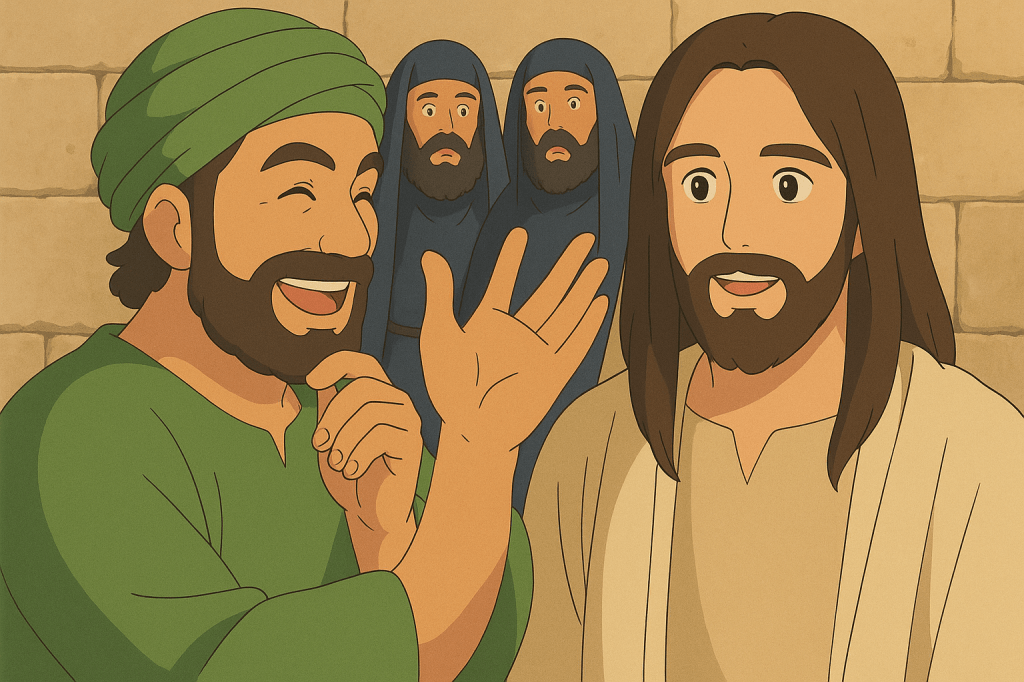
The irony is that Jesus chose to heal this man on the Sabbath. It seems the man was brought in intentionally so the leaders could accuse Jesus of breaking the law. But Jesus, knowing their intentions, wasted no time. He called the man to stand before everyone and then commanded, “Stretch out your hand.” Immediately, the curled-up hand opened—fully restored for use.
The leaders watched the healing and became furious, plotting against Jesus—not for doing wrong, but for doing good. This reminds us that some people will accuse or oppose you even when you do the right thing. In our world, few seek approval to help, while many are selective about who receives the honor, even placing human-made laws and restrictions on when, where, and to whom good should be done.
This is the spiritual “withered hand” disease—shrinking our ability and willingness to help. But Jesus demonstrates that compassion has no restrictions. There is no set place, time, or person required to do good—just do good.
Bible also teaches, “So then, as we have opportunity, let us do good to everyone.” – Galatians 6:10
To all who feel their “hand” has withered—whether through fear, criticism, or discouragement—Jesus commands you today: Stretch out your hand. Stretch your horizon. Stretch your ability to do good any time, any where and to anyone.
Prayer:
Dear Father, thank You for the help we have received in every circumstance. Help us, guide us, and lead us to do good to others in all situations. Amen.
“For whoever drinks of the water that I will give him will never be thirsty again.” – John 4:14
Jesus and His disciples take a diversion into the least favorite place for the Jews—named Samaria.
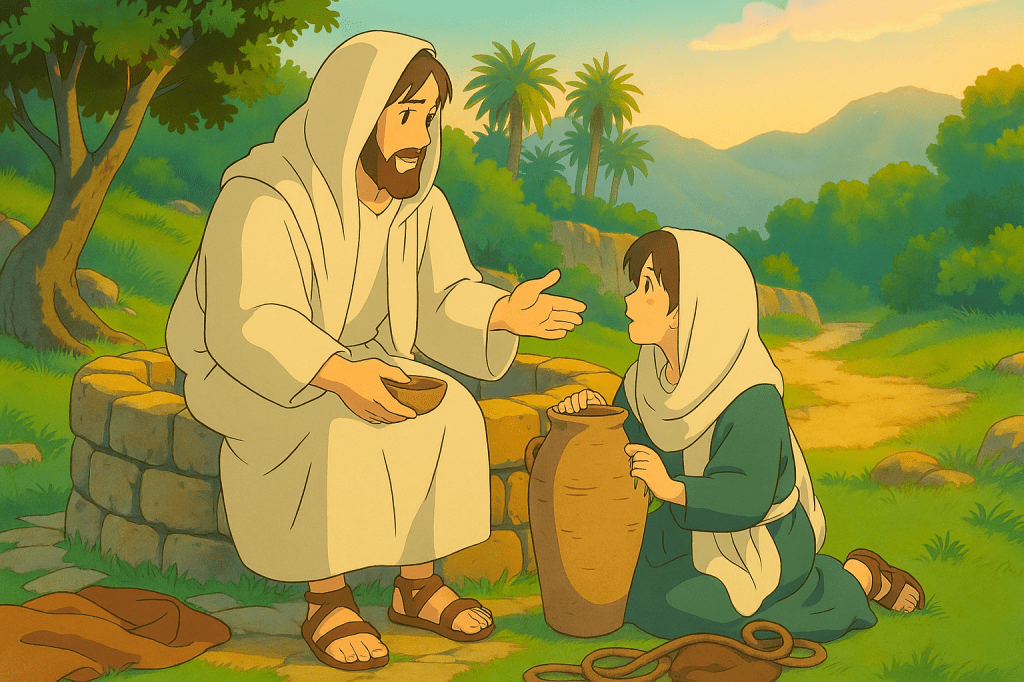
One woman from a socially outcast community comes to draw water around noon. This was a very odd time for women in those days to draw water. The act of drawing water was also a social gathering to meet and greet other women, which usually happened either early in the morning or late in the evening. It seems that this woman had chosen a time when no one else would be around the well.
The Bible says that this woman had been rejected by five of her husbands, which might also be a reason why the other women in the society did not accept her. She seemed to be a complete package of rejection, pain, and isolation.
In a surprising moment, Jesus engages in conversation with this woman—someone who isolated herself because of who she was. In her loneliness, she meets someone great in that lonely place, alone.
Jesus speaks her love language, using the metaphor of water. He reveals that He is the Living Water, representing spiritual nourishment, and also declares the greatest message of all time—that He is the prophesied Messiah, the Savior of the world. The woman’s reception of this truth is like an encounter with a well of love.
The love of Jesus Christ satisfies her thirst and longing for genuine love, which had been denied to her. The revelation of who Jesus Christ is transforms her from brokenness to boldness. She runs into the town of Samaria, carrying the message of love and the Source of love—Jesus Christ.
The joy was overflowing; she couldn’t contain it. The same lonely feet that once dragged in despair now ran with joy to share the truth.
Rejection is so real, even in this modern world. Rejection is one of the main causes of depression. We can experience loneliness and isolation, even when surrounded by many—it’s a slow poison that drains our body, mind, and soul.
To all the outcast reading this—the word of encouragement comes to you: Drink from the well of Living Water, Jesus Christ. He never runs dry. As you dig deeper for truth, the Living Water will overflow with love that will stop your thirst for human love.
God’s kingdom has a greater inclusion policy—you are part of a divine plan. His plan includes you, and as it fills your heart, your feet will automatically run to share the great news: the love of Jesus Christ.
Get ready. Dig deep. Drink in abundance—and never thirst again.
Prayer:
Thank You, Father, for Jesus Christ. Thank You for the privilege of being included in Your kingdom. Fill me with Your Living Water. Amen.
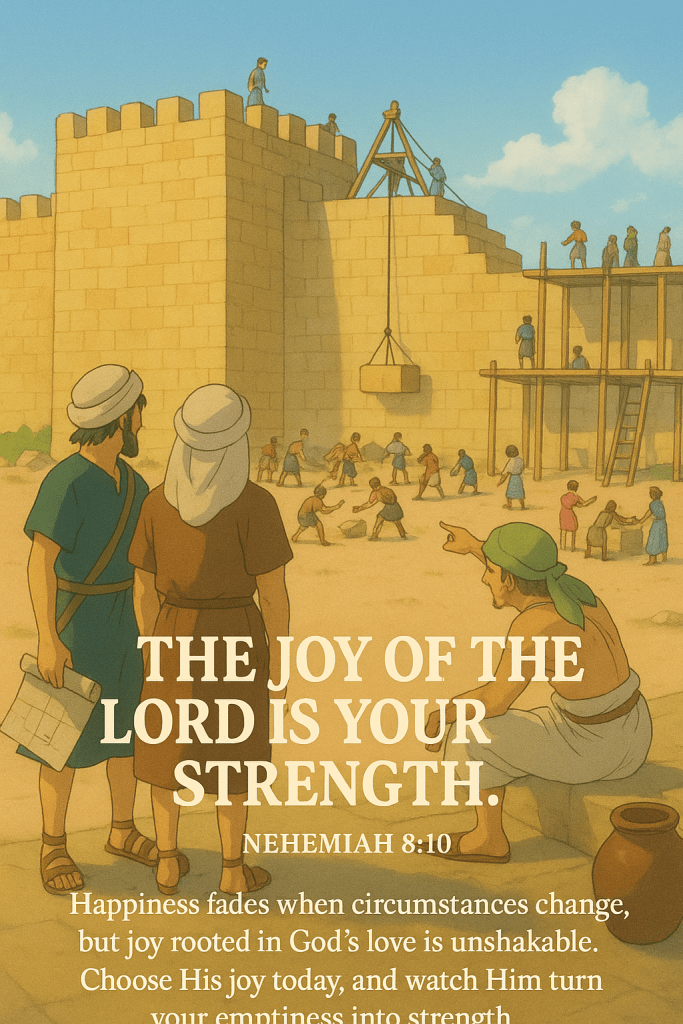
“The joy of the Lord is my strength.” – Nehemiah 8:10
Picture this: the walls of Jerusalem finally stand tall again—stones stacked high, gates restored. Nehemiah and the people have accomplished what once seemed impossible, rebuilding in the face of threats, ridicule, and fierce opposition. It’s a moment that should be filled with cheers… yet Scripture says the people were weeping. Nehemiah reminds them, “The joy of the Lord is your strength.”
Have you ever been there? You’ve rebuilt after heartbreak. You’ve overcome hardships that could have crushed you. You’ve accomplished what once seemed unreachable. But instead of celebration, you feel a strange emptiness.
That’s because happiness tied to circumstances can fade as quickly as it comes. Lasting joy—soul-deep contentment—flows from God Himself.
The good news? The joy of the Lord is your strength. This is not a fleeting feeling but a spiritual power anchored in God’s character, His unshakable faithfulness, and His steadfast love. It’s a joy that stands firm when storms rage, and it’s the strength that keeps you going when the battle isn’t over.
Joy is a choice—a decision to trust God’s promises and train your soul to believe He is in full control of your past, present, and future. And when His joy fills your heart, grief begins to turn into gladness.
Even David—mighty warrior, giant-slayer, and king—once cried out in Psalm 51:12: “Restore to me the joy of Your salvation.” He knew that without God’s joy, he was vulnerable and weak.
The enemy of our souls comes after our joy because without it, we are left empty and powerless.
So I’ll ask you: What’s stealing your joy today? Fear? Doubt? Disappointment? Or ignorance of God’s truth? Romans 8 assures us that nothing can separate us from the love of God.
Today is a call to restoration—a call to take back your joy. Choose the joy of the Lord. Choose His strength. And watch Him transform your life from the inside out.
Prayer:
Lord, please forgive my sins, my unbelief, and my ignorance. Today, I choose to believe in Your love displayed on the cross for me. I choose to receive Your joy. Amen.
Jeremiah 18:6 – “As the clay is in the potter’s hand, so are you in My hand.”
This scripture beautifully illustrates God’s authority over our lives. Like a potter shaping clay, He works tirelessly—forming, refining, and molding us into something purposeful. The potter may break down and rebuild the clay again and again until it takes on the exact shape he envisions. His goal is to create a vessel that can either hold something valuable or stand as a work of art for display. When the work is complete, the potter marks it as his masterpiece.
Likewise, God—the Master Potter—holds our lives in His hands. Even in seasons of brokenness, He is not discarding us; He is reshaping us. Every press, every turn, and every remolding is part of His process to make us into vessels of honor—living testimonies of His goodness.
Further down in this passage, we see a call to repentance—an invitation to yield to His hands, like clay that does not resist the potter’s shaping. When we surrender, He can complete His perfect work in us and leave His unmistakable mark so that all can see we are His handiwork.
If your current season feels shattered, remember: you are still in the Potter’s hands. This brokenness can become your breakthrough—if you trust His process.
It was the night of my breakthrough. I went into a dark room, shut the door, and wished to disappear into the shadows. I could hear one of my siblings weeping loudly—breaking religious pictures, throwing away spiritual objects, fighting with God, questioning Him, accusing Him of being distant, of not hearing our cries.
I had already exhausted every tear. I lay still, listening to all the chaos. Strangely, I didn’t feel anger toward God. I don’t know why—but even when I briefly closed my eyes, I could sense a powerful presence coming upon me. I tried to get up and resist the heaviness. I tried to speak, to call for help—but no one could hear me. It wasn’t frightening; it was comforting. I stopped resisting.
And then—I saw a vision.
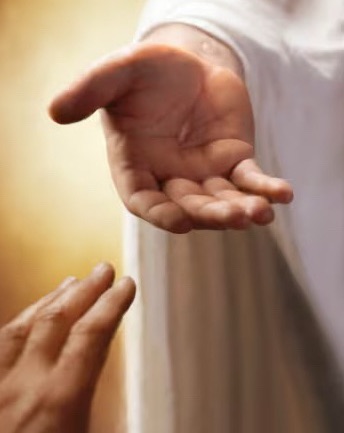
A mighty, marvelous hand descended from the sky. It picked up a black pen crowned in gold, along with a piece of paper. The hand began to write. In the vision, I asked, “What are You writing?” A voice replied, “I’m writing your blessings.” The hand then picked up a book—what I believed to be my Bible—and underlined something. I didn’t know what it was at the time, but the Lord revealed it to me in the days to come.
After hearing the voice, an unexplainable peace filled me. I was caught between vision and reality. I could still hear my family weeping in the living room, but my spirit had touched something divine. I stood at the entrance of the bedroom, confused. My family looked at me, alarmed, thinking I was mentally disturbed. But they couldn’t understand—I had just experienced something supernatural. I didn’t say a word. I feared they would think I had lost my mind. I quietly returned to bed and rested.
But not for long.
Around 3 AM on July 3rd, we received an emergency call from the hospital. My husband’s condition had worsened. The doctors said his brain was dead. They wanted to inform the family that he could pass at any moment. I rushed back to the hospital.
I stood in the lobby, lost in thoughts of what I had just experienced. Was it real? Or was it a dream?
As the doctors prepared to declare him dead, I refused to see him. I couldn’t. I hated my life in that moment. I felt like a failure. Ashamed. I shut my eyes—I didn’t want to see anyone. His parents were ushered in to see him one last time. My mother-in-law, weeping, held my hand and said, “I gave birth to an unlucky son.” She begged for forgiveness—for leaving me and my daughter behind in this unbearable pain.
But I had turned to stone. I didn’t open my eyes. I didn’t speak. Many came and went. I heard voices but couldn’t respond. This went on until around 11 AM.
Then, a man of God entered. I had never met him before. He gently tried to speak with me, but I stayed silent, eyes still closed. He offered a prayer. Then he asked softly, “You don’t have to talk. But can you come with me for a coffee?”
Surprisingly, I opened my eyes. I followed him to the cafeteria. He handed me a coffee and prayed over me again—a short prayer. I don’t even remember the words. But something happened. I felt a wind-like presence sweep over me. My mouth began uttering unfamiliar words, a language I couldn’t understand. It wasn’t me—I was praying or speaking in tongues. It was supernatural.
I rushed to a nearby bathroom and began vomiting. The presence hadn’t left. I felt a weight being lifted. My lips continued to move in that unknown language. I hesitated to come out. While in the bathroom, I started bleeding heavily—my period had started unexpectedly. Everything was happening at once.
I asked the man of God to send one of my family members to help. They took me to a nearby relative’s home to shower and change. My mother-in-law hugged me tightly, relieved to see me looking normal again. I came back to the hospital with a quiet boldness inside me.
I went to the lobby to collect my ID and entered the critical care unit. Only two visitors were allowed at a time. My husband’s pulse had been just 10 earlier that morning—but now it was over 80. A nurse was by his side, documenting vitals.
I spoke to him. His eyeballs moved beneath his eyelids. His hands and legs twitched. I called the nurse’s attention, but she looked at me blankly—he was “brain dead” in her eyes. Still, she noted the vitals again.
To me, those little movements were miracles. My hope shot up like a mountain.
I brought my sister back with me. As we stood beside him, I began to hear a loud cry—as though someone were being attacked. I stepped back to see if another patient was making noise, but this floor was for the brain-injured. Most were unconscious. The halls were empty. But the cries didn’t stop.
My husband didn’t move, but the atmosphere had shifted. It felt like a battlefield—and the battle felt like it was in my favor.
Later, I asked my sister if she’d heard any of it. She hadn’t. I didn’t explain. I was slowly realizing that these were supernatural experiences.
We sat by the window. I prayed: “Lord, I don’t understand what’s happening. I don’t know why I’m going through this. Please give me grace to face what’s ahead—for me and my daughter. I surrender us into Your hands.” And I thanked Him for all the turmoil I was going through.
I still hoped for a miracle. But no change came.
He remained on life support for six days. I began visiting churches and praying endlessly. On the fifth day, someone suggested, “Why don’t we pray for God’s will instead?”
I hesitated. What if God’s will was to take him away?
Meanwhile, his parents pleaded with me for consent to remove life support. The doctors had confirmed he would remain in a vegetative state. They couldn’t bear to see him like that. I argued—I said I’d take care of him, no matter what. I couldn’t bear the thought of denying someone their life.
But their pain crushed me. I couldn’t take it anymore. I ran out of the hospital, all the way to the main road, and cried out, “Lord, let Your will be done.”
The next morning, I heard a still voice inside me say, “This is the day. Be prepared.”
I was sitting in a new church I’d never been to before. The calm was unusual. They prayed for me, fed me. While eating, I received a call—the dean of the hospital wanted to meet. My husband had suffered two massive heart attacks the night before. He had been treated, but chances of survival were slim.
I knew in my spirit—this was it.
I stood up from my half-eaten meal. As I left, my eyes caught a scripture on the wall: Psalm 46:10 – “Be still and know that I am God.” It struck my heart deeply.
At the dean’s office, he gently explained the situation. He told me I was young and had a life to live. I replied, “I will take care of him—even if he’s in a vegetative state.”
He wasn’t pleased. As we spoke, the phone rang. It was the nurse—my husband had suffered another massive heart attack. The doctor asked me, “What should we do?”
I said, “Do CPR. Keep him breathing.”
Reluctantly, he passed on the instruction.
My mother and I rushed to his room. But the medical team had already begun CPR. His pulse dropped rapidly—and my hope vanished before my eyes.
Tears flooded. I whispered in his ear, “I love you.” And I told myself, Until we meet at the other end. I remembered how he once promised to be with me until the end of life’s journey. For the first time, he broke that promise.
On July 9, 2013, his spirit left him. It was a devastating moment.
I walked out to find family, friends, and colleagues—all in tears. My daughter ran around the hospital, playful and unaware. It was heartbreaking.
Yet, despite everything, the peace I had never left me. I wanted to scream, to wail—but I couldn’t. The sorrow didn’t sink in as I expected.
The next hours are a blur. All I remember is his lifeless body in a van, traveling for nine hours to his native home. That night was unforgettable—a mix of tears, prayers, and strange comfort. I felt the love of Jesus poured over me like water—pure, deep, and beyond human understanding.
When we arrived, the weeping intensified. One of his closest friends, who had a wedding on July 10th, hadn’t been told the news. When he found out, he came running. The last cries shook the atmosphere.
It was painful to accept the fact that I’m not going to see him anymore.
That goodbye was the hardest.
But I thank God—for allowing me to know and love this man. I learned humility, simplicity, genuine love, respect and grace from him. He was well-mannered, brilliant, and kind. The world was too cruel for someone like him. Heaven deserved him more.
The Next Chapter
What followed was surreal and miraculous. I had dreams, visions, and supernatural encounters. It was as though God had ordained and prepared every detail. Strangers showed up to help. Doors opened. Blessings poured out.
Psalm 46:10 became my anchor: “Be still and know that I am God.” I wasn’t wise enough to plan or sort any of this by the way it was planned and sorted. But God made a way.
Eventually, I returned to the U.S. Miraculously, my job became permanent. Favor followed me from every corner .
Then, God revealed the words that were underlined in my vision:
Romans 8:28 – “All things work together for good to those who love God.”
This wasn’t just a verse. It became my life application .
Twelve years later, I can testify: every high, every valley, every sorrow—all worked for my good. God’s hand guided me. His voice led me. His faithfulness never failed. And this song never left my lips:
“Great is Thy faithfulness!”
“Great is Thy faithfulness!”
Morning by morning new mercies I see;
All I have needed Thy hand hath provided—
“Great is Thy faithfulness,” Lord, unto me!
I am deeply grateful—for the kindness of family, friends, in-laws, pastors, colleagues, and all who prayed for me. A big shout out to two women in my life, my mother and mother in law for the prayers , encouragement and trust they have on me. The relationship with my in laws still going strong by the grace of God and moments we share is a pure joy.
I can surely say life is not easy, but it is not hard when you have God at your side.
And if you’ve read this far, I pray that the same love of God finds you, comforts you, and carries you.
It was the last time my husband was conscious enough to recognize me.
In the blink of a second, everything changed. The doctors in the room were having serious discussions. I wasn’t allowed in. My heart raced as I stood outside, helpless, trying to make sense of the chaos. Then, they moved him to another branch of the hospital.
The diagnosis was devastating—a massive stroke in the brain stem. The doctors were shocked. He was just 34 years old—no smoking, no drinking, a regular at the gym, a healthy adult by every standard. They were furious and confused. I had never once seen him sick. He had never complained of any illness.
To me, everything went blank.
That night, I sat alone in the hospital lobby, numb and disoriented.
The next day, my mom arrived. She had left my three-year-old daughter in someone else’s care to be with me. The moment I saw her, I broke down. I sobbed uncontrollably in her arms. She looked shattered too—seeing the youngest of her five children, the baby of our family, facing such a situation.
She did her best to comfort me, though I knew she was breaking inside.
Still, I was forced to gather myself. I had to be strong enough to take him for ultrasounds and other tests. His eyes never opened. Not once.
Yet again, I had to travel alone with him in an alarming ambulance to another hospital branch. There, the doctors prepared for emergency brain surgery. The clot was putting dangerous pressure on the skull. They had to open it to relieve it. Prayers poured in like clouds from all corners. I held onto hope—any sliver of it—for a miracle after surgery.
But what followed broke me even further.
The doctors wouldn’t give me proper updates. One of them coldly said, “Are you expecting me to say your husband is alright?”
That single sentence crushed my heart. I realized something deeply painful:
My pain was mine alone.
To that doctor, my husband was just another patient.
To me, he was my whole world.
My in-laws and sister-in-law, along with my siblings, flew in from around the world to be with me. Their presence meant the world.
Still, I struggled to face my in-laws. They are some of the kindest souls I have ever met, and this—this was their only son. I could see the sorrow etched into their faces. Yet, with unimaginable grace, they kept their pain aside to give me hope.
They came straight from the airport to the hospital. Being medical professionals themselves, the doctors spoke more openly with them than with emotionally overwhelmed me. But even then, there was no real improvement. Just observation. More waiting. More despair.
I sent everyone back home and chose to stay another night in the hospital—alone.
This time, I wasn’t allowed near the critical care unit. I had to stay in a separate building. I walked through dark hospital pathways, full of fear and uncertainty.
The infrastructure didn’t scare me—the pain did.
Family members clung to each other, crying, praying, whispering desperate hopes for their loved ones. The air itself was heavy with grief.
I don’t remember eating. I barely slept.
And watching others suffer only deepened my ache.
I wished I had a healing wand to make everything better—for them and for myself.
I spent the whole night walking between the hospital and lodging building.
At one point, someone asked me if I had admitted an elderly person.
I couldn’t even form the words to explain what had happened.
Soon, my family arrived again the next morning. My eyes were swollen from days of tears. I waited anxiously for the doctors’ morning rounds. I hoped—pleaded in silence—for good news.
Instead, I was told the other side of his brain had started bleeding.
My hope began to crumble.
Fear.
Anxiety.
They gripped my soul like never before.
My siblings softened their words, trying to cushion the blow. But I understood.
Others in the hospital lodge began asking, “Why are you here alone? What’s going on?”
Slowly, I started to open up. They began to share their pain too. We cried together.
We held on to each other.
We whispered encouragement.
We begged heaven for mercy.
I saw some patients move to normal wards.
Some were discharged.
Something good was happening around me—but not to me.
Not yet.
It became a ritual—I stood before the doctors during every round.
They gave me bad news after bad news.
And afterward, I would sit alone in the lobby, watching everyone walk in.
Everyone who entered that building had a story.
One day, I saw a young woman rush in, crying. Her husband had a brain injury from an accident. She was frantic. Something stirred in me.
I walked over. I listened. I comforted her.
“I believe your husband will be okay,” I told her gently.
She hugged me with tear-filled eyes.
In that moment, I felt something good—for the first time in days.
Even though I knew the doctor would soon come to give me another terrifying update.
In that hospital I saw babies treated for brain cancer.
Young children.
Elderly people.
Some went home.
Some didn’t and was declared dead.
The hospital was a sea of emotions.
I started to sit quietly and listen to my soul.
Why am I going through this?
What is the purpose of this pain?
I had chosen a simple life.
Yet, What lesson was hidden here?
In that silence, something began to speak to me.
A glimpse of my future—who would help me, what I would walk through.
It came like a movie in my mind.
I kept it to myself.
I wasn’t sure if it was divine or just my imagination.
After several days, my family insisted I go home.
My daughter had started to ask for me.
It had been few days—and I hadn’t even thought about her.
When I walked through the door, she ran into my arms.
Her tiny hands wrapped tightly around my neck.
She kissed me endlessly.
Her puzzled face said everything, but she didn’t ask about her daddy.
My husband was placed on deputation to the USA, and we had to return to India for a brief while. People in the IT industry might understand this process better—it’s a common norm for Indian IT consultants. We packed all our belongings, including our newly purchased car, and put everything into storage, anticipating our return after the visit.
The three of us boarded the flight with excitement and anticipation. After two and a half years, we were finally going to see our family and relatives again. While we were in India, we visited familiar places in our hometown and had numerous get-togethers with loved ones. It was joyful, comforting, and filled with laughter. I felt truly blessed.
During that time, we were invited to attend a wedding—an 8-hour road journey away. The night before the travel, I had an unpleasant dream that left me disturbed. As I packed our suitcases, I told my mom that I didn’t feel right about going. She gently suggested I cancel the trip. But I didn’t want to disappoint my husband—he comes from a large, close-knit family and was looking forward to meeting everyone. They were excited to see us, and I didn’t want to let anyone down.
As I continued expressing my unease, a crow suddenly fell from the sky near our side door. It looked injured and was dying. I didn’t know how to help. Soon after, our house helper came rushing to assist. As I watched, I noticed a tree nearby—one that was always lush and fruitful—now completely dried up. It had been green just the day before. Something didn’t feel right deep within me. Despite that, we boarded the sleeper bus and reached my husband’s hometown safely after the overnight journey.
We rested for a day at my in-laws’ house. The next day, we traveled another four hours by car to the wedding venue, bringing my in-laws along. The entire hotel was buzzing with celebration. The rooms were filled with my husband’s relatives—so many happy faces, dressed in silks, adorned with gold jewelry and jasmine flowers. There was laughter, dancing, and endless food.
My husband was filled with joy. It was his cousin’s wedding—someone he had grown up with. Their bond was deep, and the celebration reflected that closeness. Yet, amidst the festivity, I couldn’t find my husband for a few hours. He was busy moving from one place to another. My in-laws were also occupied in conversations, and I found myself alone with our three-year-old daughter during lunch.
As I sat down to eat, an eerie feeling came over me. I felt this strange thought—this is how I’m going to be left soon. My fear grew, but I said nothing.
After the wedding, we returned safely to my in-laws’ home and planned a trip to visit a waterfall. We reached the place late in the evening. The area was dark due to a power outage caused by strong winds and heavy rain.We somehow found the house we had booked, but the property owner advised us to leave since he didn’t have a generator and couldn’t guarantee when the power would return.
The winds were so violent—I called them devil winds. We moved from that location and drove at least another hour through pitch-dark roads. Eventually, we found a small hotel that had one room available. It was barely enough for all of us, especially since we had also brought my nine-year-old nephew.
I was anxious. The darkness, the isolation, and the night itself felt unsettling. In the bedroom my husband placed me, our daughter, and my nephew on the bed and he slept on the floor beside us. My in-laws stayed in a kind of living room outside. The howling of the wind outside was terrifying.
Inside the room, something felt off. My spirit was not at peace. I felt a strange sensation—as if someone was lifting the bed I was lying on. I checked on my husband; he looked at me and asked if everything was okay. I told him what I felt. He reassured me it was nothing and told me to sleep.
But I couldn’t. The presence in the room felt unnatural, unfamiliar—like a stranger among us. I reached for my Bible, said a simple prayer, and placed it under my pillow. Somehow, I managed to sleep.
The next morning, my husband was eager to reach the falls early, before the crowds arrived. It was a calm morning, and everyone looked happy. But deep inside, I felt an unshakable sadness. I looked at my husband—he was laughing, glowing with happiness—but something in me whispered that something was wrong. I dismissed it as my usual overthinking.
That day and night at the falls, the strange unease followed me. I longed to return home. Eventually, we traveled back to my in-laws’ house and then boarded the sleeper bus to my parents’ place.
On the bus, my daughter and me was resting in one sleeper berth, while my husband was in another across from us. I woke up at one point and saw him sitting up, looking out the window. We were nearing my mom’s house. Still, the heaviness in my heart hadn’t left.
We reached safely. But my husband’s face looked different—subtly off. I asked if he was okay, but he just nodded. He took me in the car to drop me at work. The ride was silent. We didn’t speak. The fear in my soul lingered.
He dropped me off, and something in me paused… he looked at me as if to say goodbye for the last time. That was the last time I saw him as his normal self.
I got home from work alone that night. He usually arrived later, so I sent him a text and laid down. As I closed my eyes, I saw the image of a woman crying—it was so vivid and strange. I rebuked the vision in prayer and drifted into a deep sleep.
Unbeknownst to me, my husband had returned from the store, eaten dinner, and sent a late-night message to his sister on social media. I did not even feel the usual kiss on my forehead that he gives me before going to bed.
The next morning, I saw him struggling to get out of bed. At first, I thought he was joking, but he looked helpless—slipping and trying to rise. I screamed. My mother and our helper rushed in. At that moment, he didn’t seem to recognize me. My daughter sat near his head as he gently patted her, but he couldn’t speak. My three-year-old didn’t understand what was happening—she played beside him like it was just another day.
We called for an ambulance. I left my daughter behind with my mom and rode with my husband. Everything felt surreal—like a terrible dream I was desperate to wake up from. Traffic was heavy, and cars wouldn’t make way for the ambulance. My soul was begging for help. My husband was conscious but unaware of his surroundings, unable to recognize me.
We reached the hospital, at the ER, the staff rushed to help him. I stood outside, peering through a small glass pane. Then I saw something that shattered me—he was vomiting blood. Until then, I thought it was something minor. But seeing that… I broke down.
I clutched my Bible, praying silently, lips moving without sound. A hospital attendant asked me to wait outside. I stood there—alone. No friends. No family. No one to hold me.
That moment taught me what it means to be helpless, hopeless, and alone. I remembered the voice that once warned me: “This is how you’ll be left.” I felt like a madwoman, walking aimlessly, unsure if this was reality.
Eventually, my in-laws arrived, followed by relatives and friends. But even in the crowd, I felt utterly alone. I missed my husband’s strong, comforting voice—the voice I had fallen in love with. Everyone had questions, but I had no strength left to answer them.
I spent the night in the hospital, awake and praying, waiting for a miracle. Finally, a nurse called my name and allowed me to see him.
He looked at me and teared up, seeing me cry.
I touched his hand—he held it tightly and placed it on his chest, tears silently rolling down his cheeks.
I told him I loved him, and that he would be fine. I whispered in his ear to pray and ask God for help. As I stood beside him, his vitals began to shift again. Alarms rang, nurses rushed in, and I was once again asked to step outside.




 4mthesoul