
“But you will not even need to fight. Take your positions; then stand still and watch the Lord’s victory. He is with you, O people of Judah and Jerusalem. Do not be afraid or discouraged. Go out against them tomorrow, for the Lord is with you!”
— 2 Chronicles 20:17 NLT
King Jehoshaphat, the fourth king of Judah, walked upright before the eyes of the Lord. He loved the Lord and followed His commandments and also brought reformation in the land of Judah that placed God under his leadership. There was peace and justice in the land of Judah.
The military power was very strong, and he had many soldiers to fight, and he stationed them around the country of Judah. God was with him and the people of Judah, and this brought fear around the neighboring kingdoms. The enemies of Judah formed their alliance to bring down and capture the land. When the messenger informed Jehoshaphat about their plan, he was afraid.
A very successful king, with strong military force and positions effectively guarding his nation, was afraid of the message about enemies approaching. When fear crept in, the first thing the king did was send out an invitation for fasting to seek the face of the Lord. When the invitation was sent, people all over the cities of Judah came along with their wives and children, fasting and praying.
King Jehoshaphat, a leader who was adored and looked upon as a mighty man, stood humbly before God in front of the assembly for help. He prayed that when disasters, sword, judgment, pestilence, or famine came upon the land, the house of Judah would stand in the house of the Lord and cry in their affliction, for they knew that He would hear and save.
He revisited what God did for the ancestors and boldly declared that He would do it again for them. The strongest military people with the king admitted that they were powerless before these alliances, and that only God alone could give victory.
God sent a word after these people humbled themselves before Him. He said not to be afraid of this great alliance and told them they would not need to fight the battle: stand firm, hold your position, and see the salvation of the Lord.
God did not ask the army to go back to their houses just because He assured that the battle belonged to the Lord. Rather, He commanded the army to go out to the battlefield and they would see the hand of God.
When the word came, Jehoshaphat was encouraged. He bowed his head, and all the people bowed and worshiped, followed by a loud voice of praise. When the day of battle came, the soldiers of Judah arose early in the morning, and the worshippers went before the army in holy attire, thanking and praising God for His steadfast love.
The three alliances—the Moabites, Ammonites, and Mount Seir—invaded Judah by climbing up 3,400 feet from the Dead Sea to the wilderness of Tekoa. The Bible says that when Judah began to sing and praise, God set an ambush against these people, and they killed each other.
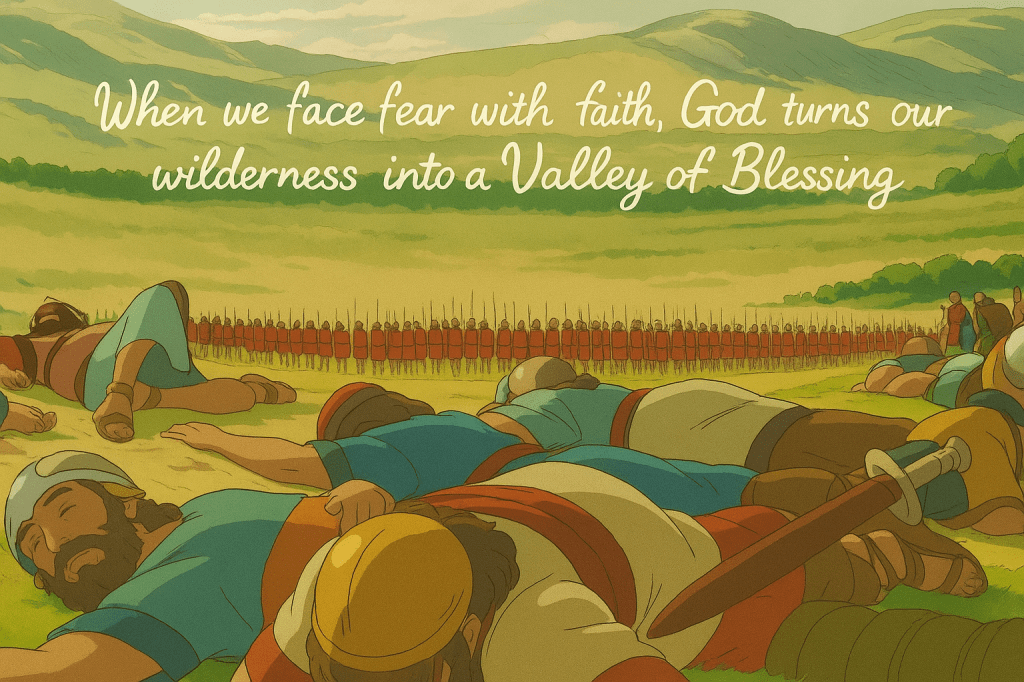
Meanwhile, the people of Judah were marching towards the wilderness of Tekoa. When they arrived, they saw only corpses and dead bodies in great number. The battle was already defeated because God was involved.
The story ends like this: they came for a battle, but they carried back blessings—good clothing and precious things. They even left some behind because they had more than enough to carry home. The army of God came back with shouts of joy, noise of victory, with happiness and instruments. The place is even now called the Valley of Beraca, which means the Valley of Blessing. The surrounding kingdoms were even more fearful of the land of Judah.
The Word of God brings encouragement today that the battle belongs to God. Like Jehoshaphat, what are we afraid of? We might be mighty people with power and possessions, but when messages like this come with fear, we lose our ground and yield to fear.
Our first defeat is when we yield to fear. When fear finds a place in our lives, there is no way we can think of overcoming the situation. Our minds are already defeated before even facing the actual battle. We only find solutions to handle the defeat and cope with failure. Success will not even cross our minds, and planning for victory will not even be part of our strategy.
But King Jehoshaphat understood that this fear was mightier than the actual army coming after him. He didn’t even have to be worried because he had a strong military force and positions around his country, and yet the enemy’s message shook the ground with fear.
One person bringing one negative word is enough to break us. King Jehoshaphat was no exception from fear. Instead of yielding to it, he dealt with it, not alone, but with a company of people.
We need more than one person to defeat this fear. It emphasizes the importance of being with people of faith to acknowledge and agree with the promises of God. The story tells us the importance of seeking God’s face in the time of crisis, irrespective of how powerful, mighty, and intelligent we are.
Like Jehoshaphat, let us go low before God and surrender to Him, acknowledging that we are powerless to handle situations alone, and that He is a faithful God—yesterday, today, and forever. When we put our confidence in God, we will deal with the situation like yet another battle, and of course, yet another victory.
Let us face our battle with praise and worship. We might walk towards the wilderness, but that is where our victory is. With our own eyes we will see the problem already dealt with, the situations already handled, and the enemy already defeated.
We might have walked in looking for a battle, but God will change our situation so that we will only carry His blessings back. Only God can make shouts of praise roar in the battleground.
May our valley of wilderness become our Valley of Beracah (blessing).
Prayer
Heavenly Father,Thank You for reminding us that the battle is not ours but Yours. We surrender our fears to You and trust that You will fight for us.
In Jesus’ name, Amen.
 4mthesoul